The letter, the sum, and the name changes
A few details that are more interesting than a slogan about “the world’s favourite train set.”
How this site works. Every historical fact is in our own words and linked to its source. Arithmetic — for example converting 4 mm to the foot into a track gauge — is labelled as arithmetic, not as a quotation. This is not a shop manual: for curve radii, controllers and compatibility, use the manufacturer’s instructions.
Meccano said the compromise out loud
Before Dublo was even on sale, a Meccano letter of 2 May 1936 told correspondents that the models would be 4 mm to the foot and the track the usual 16.5 mm. It was not an accidental mismatch discovered later. It was the plan. Double O Gauge Association
The sum that still surprises
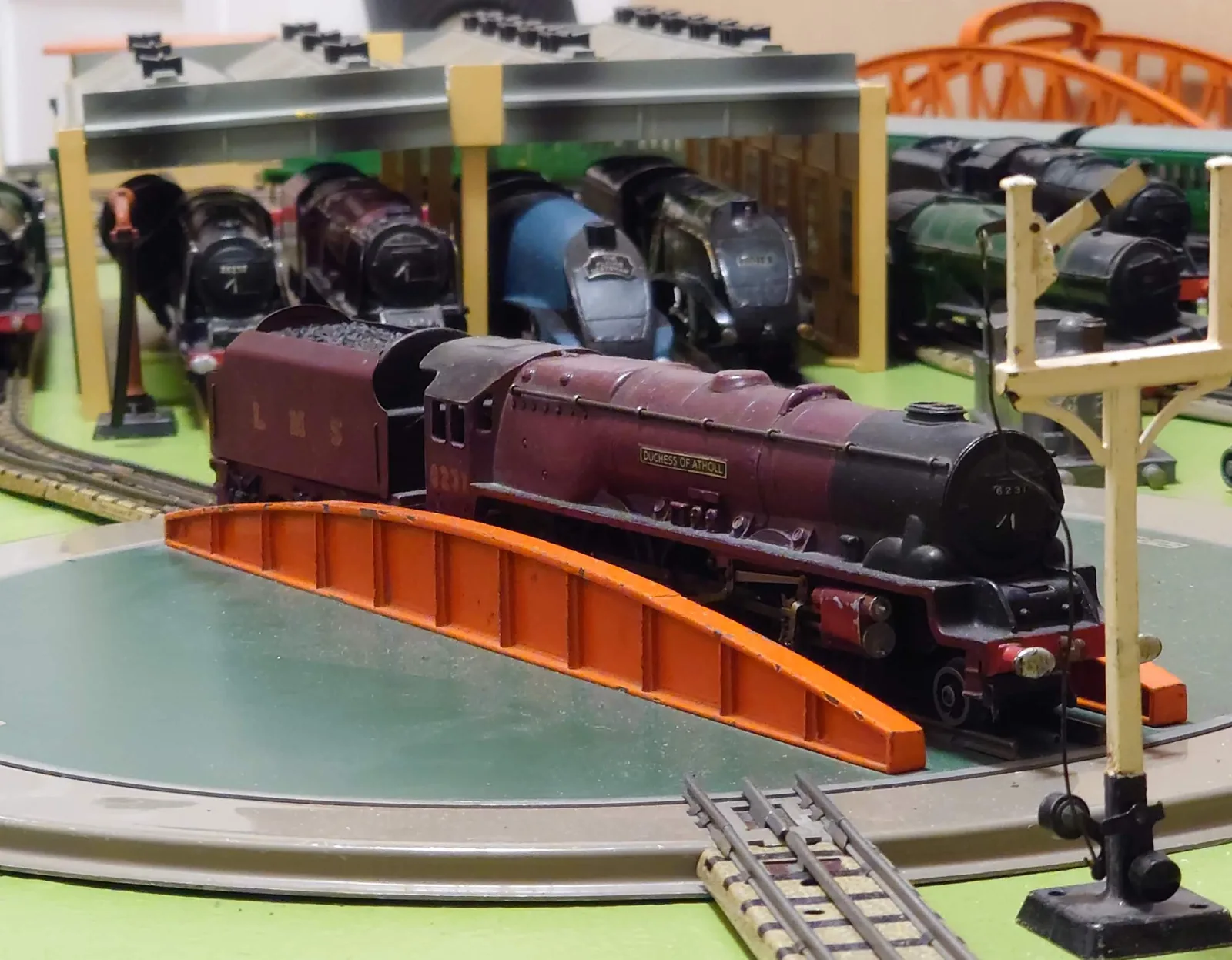
4 mm to the foot is 1:76.2. Dividing a 1,435 mm standard-gauge prototype by 76.2 gives about 18.8 mm. Commercial 00 track is 16.5 mm. The rails are closer together than a perfect 4 mm reduction would be; the locomotives look slightly large for the track. That is arithmetic from the published scale and from Meccano’s “usual” 16.5 mm gauge. Double O Gauge Association
Hornby was not the first word on the box
The official history says the Hornby name appeared in 1909 on a Meccano set, that a railway product called Raylo came in 1915, and that only in 1920 was the Hornby name used for a loose-track model railway system. Hornby Hobbies